Enhance your driving experience while enjoying a cooler, more comfortable ride.
Protect yourself from the damaging effects of the harsh Florida sun.
XPEL Certified • Fort Walton Beach
XPEL Window Tint
Cooler cabin. Sharper look. The right film for the way you drive.
Upgrade comfort, reduce glare, and help protect your interior with professionally installed XPEL PRIME automotive window film.

Comfort you notice
Tint should do more than make the glass darker.
Film construction matters. The right XPEL PRIME product can improve solar-energy rejection, reduce glare, filter ultraviolet light, and give the vehicle a clean, consistent appearance.
- Choose performance independently from how dark you want to go
- Nano-ceramic options avoid metal-based signal interference
- Computer-cut patterns reduce unnecessary knife work on the vehicle
- Film and shade are selected after we account for the existing glass
Compare XPEL PRIME
Four films. One right fit.
We help you balance heat-management goals, appearance, vehicle type, local law, and budget—without pushing every driver into the same film.
Nano-ceramic
PRIME XR PLUS
Published TSER range52–71%
- Top XPEL PRIME heat-management option
- 67–70% infrared energy rejection (IRER)
- 5–67% visible light transmission range
- Up to 99% UV rejection; non-metal construction
Nano-ceramic
PRIME XR
Published TSER range42–66%
- Strong solar-energy rejection with broad shade choices
- 55–64% infrared energy rejection (IRER)
- 5–78% visible light transmission range
- Up to 99% UV rejection; non-metal construction
Hybrid dyed-metal
PRIME HP
Published TSER range36–59%
- Hybrid construction for dependable everyday performance
- 25% infrared energy rejection (IRER)
- 4–54% visible light transmission range
- Up to 99% UV rejection
Dyed, non-reflective
PRIME CS
Published TSER range24–45%
- Clean, non-reflective appearance
- Practical UV and glare control
- 5–86% visible light transmission range
- Up to 99% UV rejection
Performance at a glance
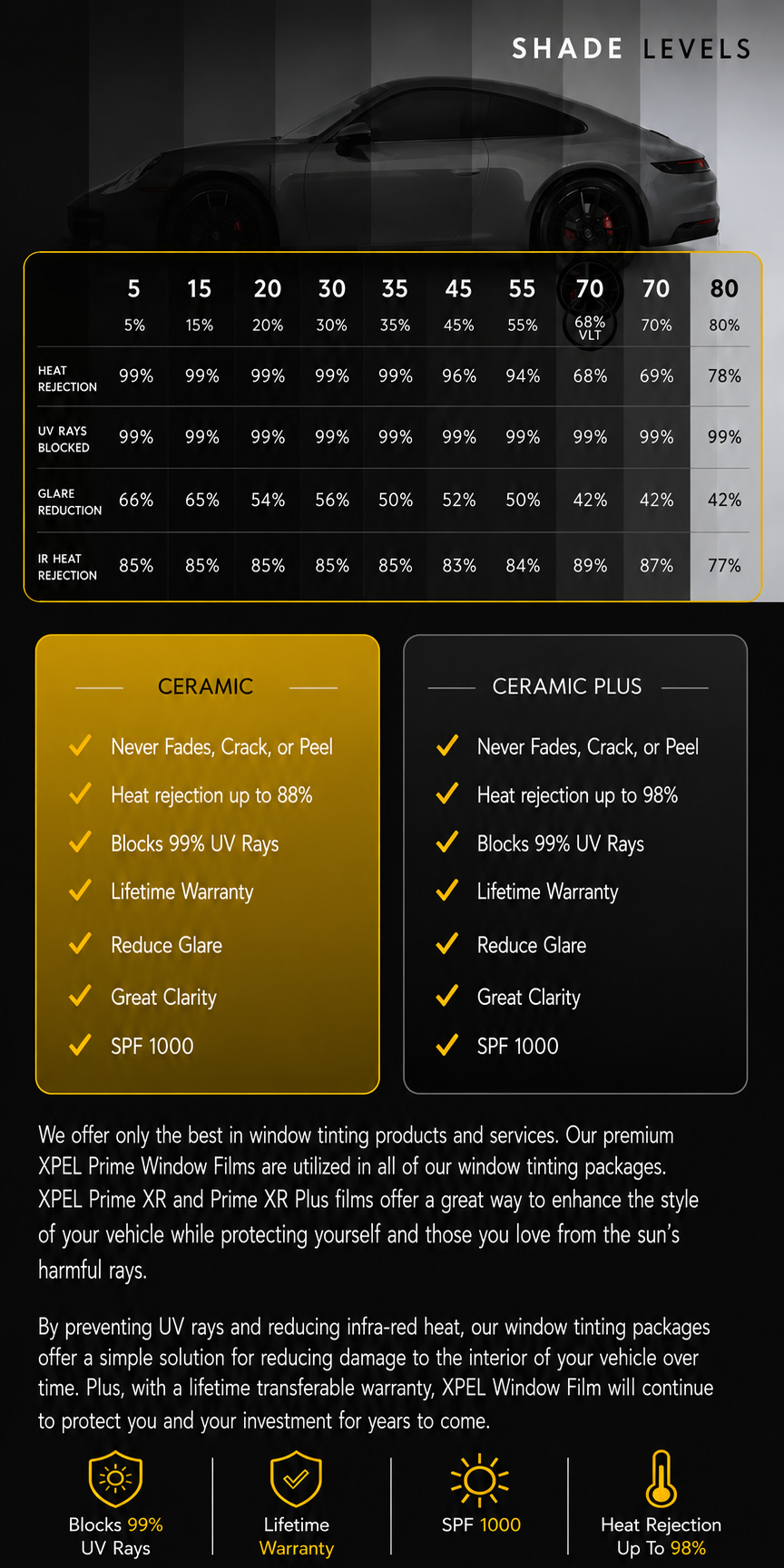
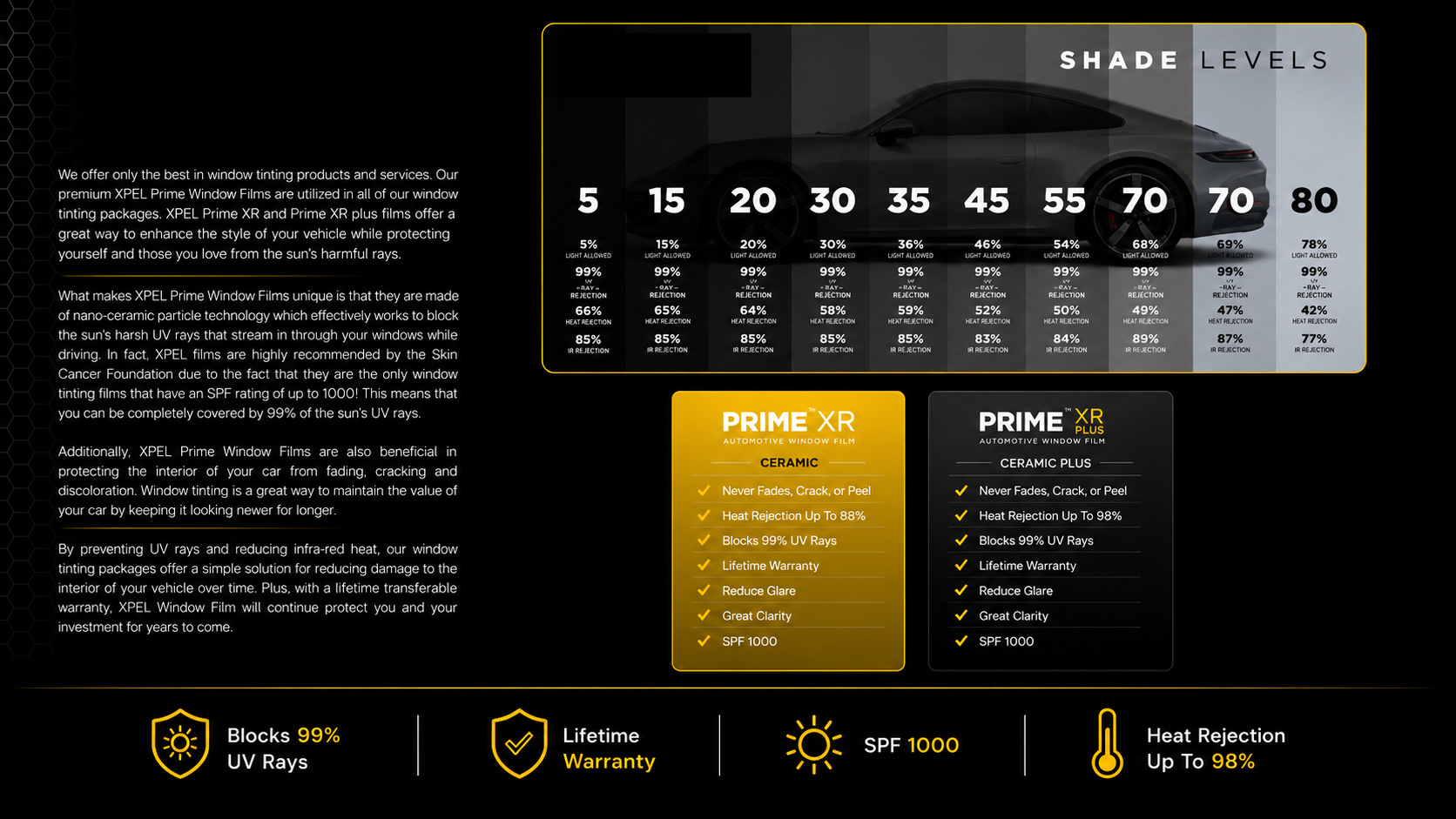
Compare the numbers—not just the shade.
| Film | Construction | VLT | TSER | IRER | UV rejection |
|---|---|---|---|---|---|
| XR PLUS | Nano-ceramic | 5–67% | 52–71% | 67–70% | Up to 99% |
| XR | Nano-ceramic | 5–78% | 42–66% | 55–64% | Up to 99% |
| HP | Hybrid dyed-metal | 4–54% | 36–59% | 25% | Up to 99% |
| CS | Dyed, non-reflective | 5–86% | 24–45% | Not listed | Up to 99% |
VLT means visible light transmission; lower numbers look darker. TSER means total solar energy rejected. IRER is an infrared-energy metric—not a percentage of all heat. Results vary by film shade and the glass on which it is measured. Review current XPEL product specifications for test details.
Florida tint, clearly explained
Legal is a measured result.
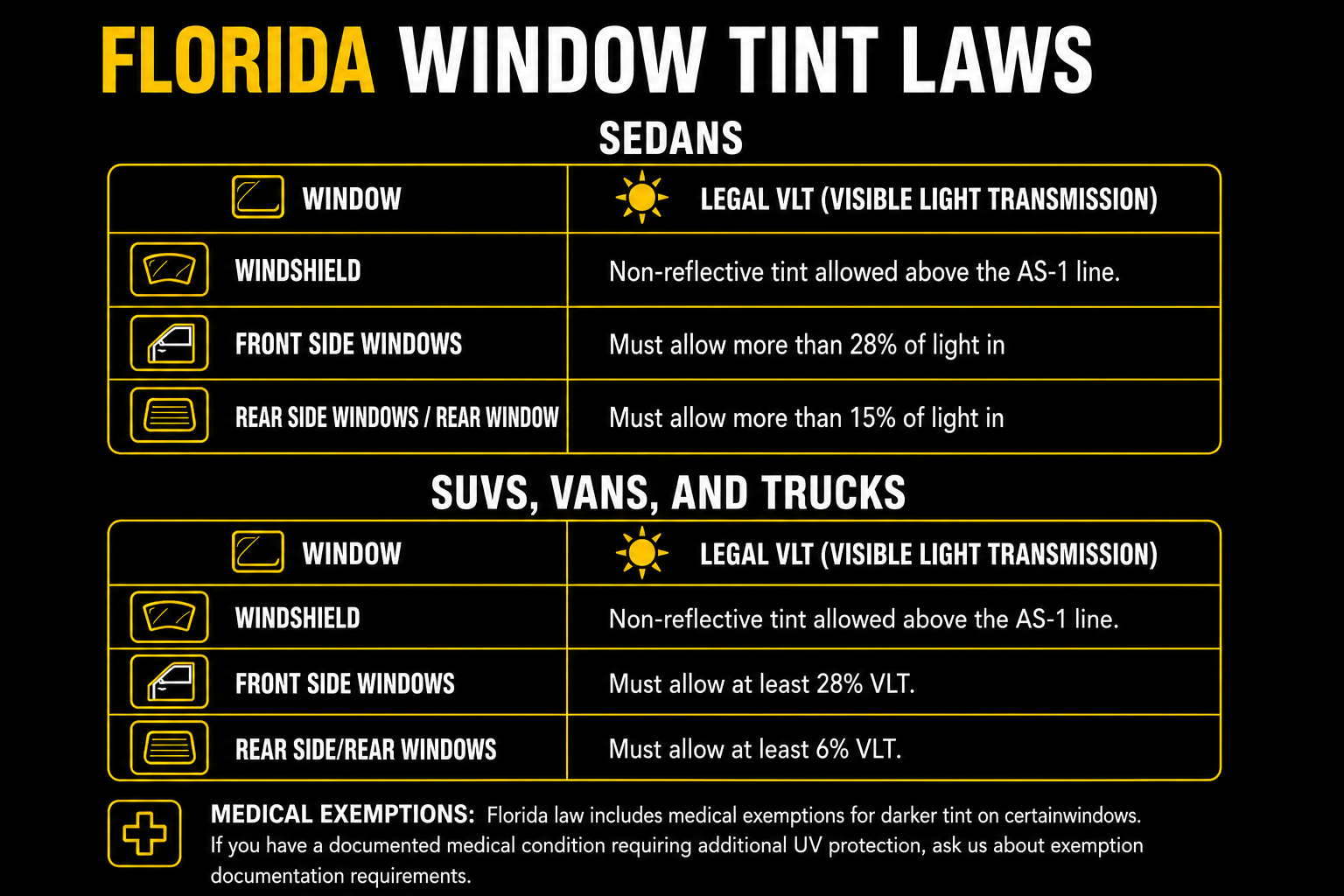
Florida regulates the light that passes through the completed window—not only the number printed on the film box. We account for factory glass before recommending a shade.
| Window | Passenger vehicle | Multipurpose vehicle |
|---|---|---|
| Windshield | Transparent, nonreflective strip above the AS-1 line | Transparent, nonreflective strip above the AS-1 line |
| Front side windows | At least 28% VLT | At least 28% VLT |
| Windows behind driver | At least 15% VLT | At least 6% VLT |
Florida also limits reflectance to 25% on front side windows and 35% behind the driver. Vehicle classification determines the rear-window limit; appearance alone does not. Florida requires a compliance label inside the left door jamb and allows a ±3 percentage-point enforcement tolerance. Medical exemptions and other statutory exceptions have separate requirements. See Florida Statutes §316.2952, §316.2953, §316.2954, and §316.2955. We will confirm the appropriate configuration at installation; this summary is not legal advice.
What to expect
A precise install,
from glass to glass.
Consult
We ask how you use the vehicle and what matters most: heat management, glare, privacy, appearance, or all four.
Measure
We identify vehicle classification and account for existing glass before finalizing a compliant shade.
Plot
Digital patterns are cut on one of our two 60-inch Graphtec plotters for a repeatable, vehicle-specific fit.
Install
The glass is prepared and film is installed inside our climate-controlled shop with close attention to edges and seals.
Inspect
We complete a final check and explain curing, cleaning, documentation, and product-specific warranty care.
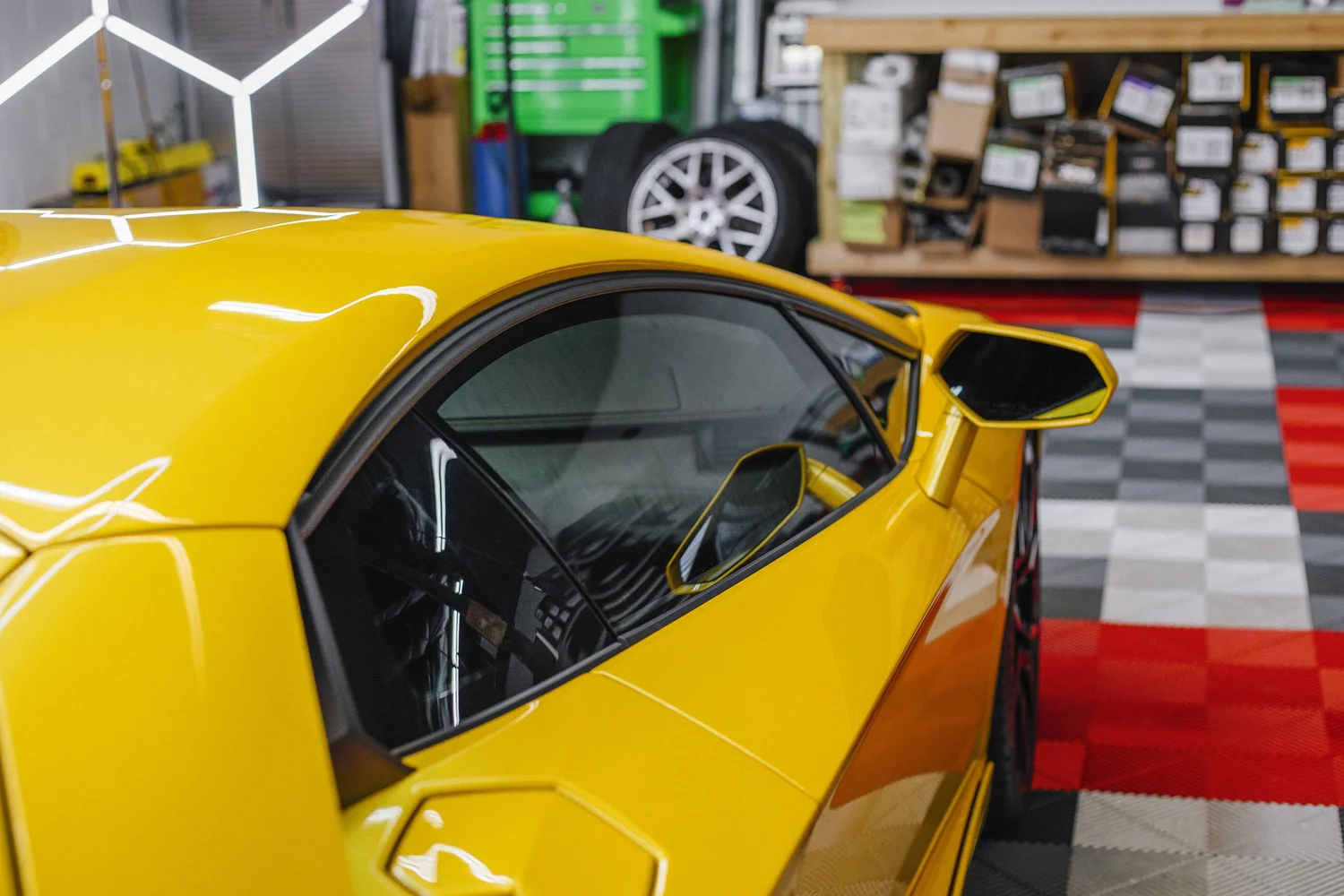
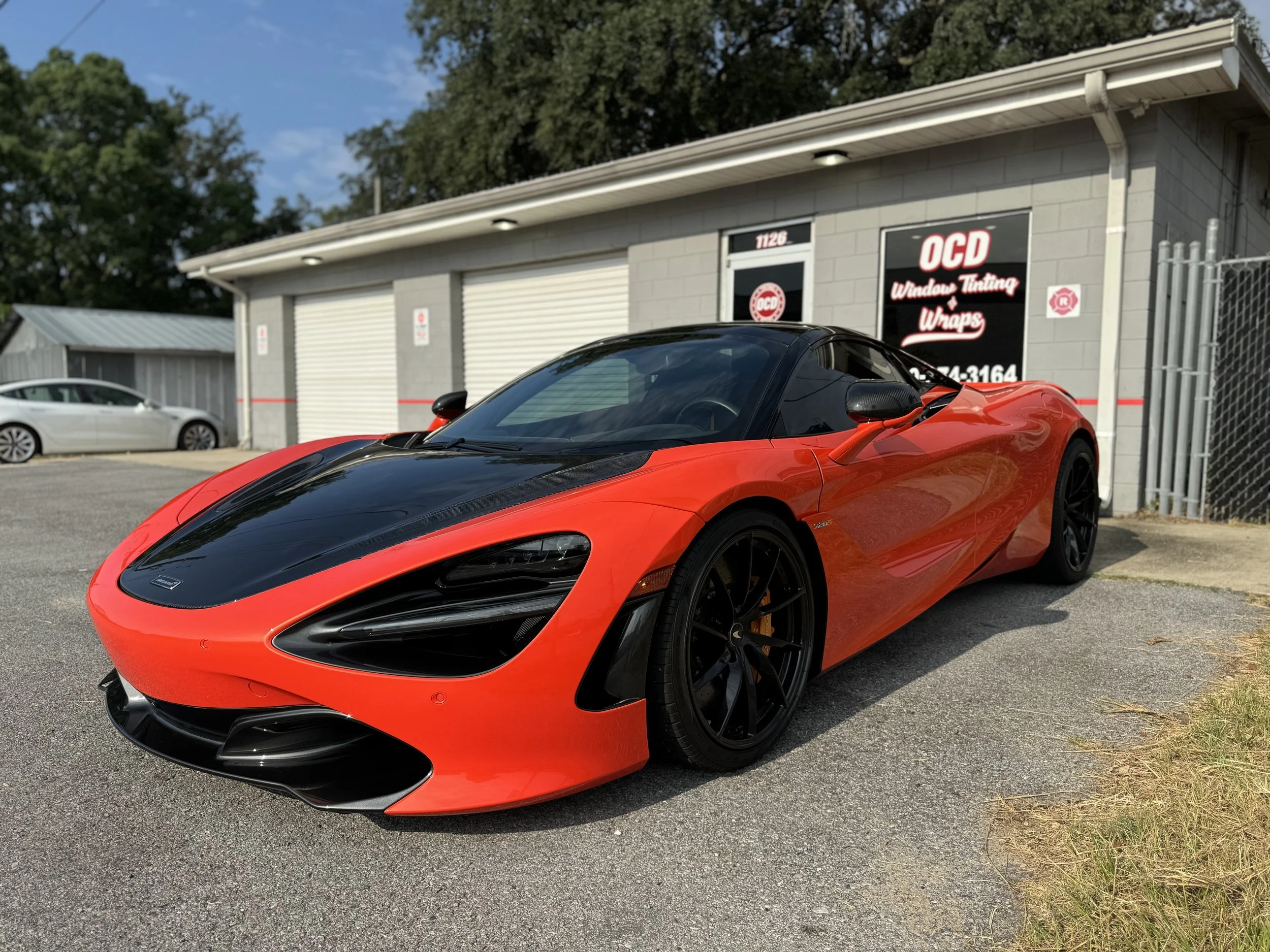
Recent work
Cleaner lines. Cooler cabins.

Why OCD
The film matters. The installer matters more.
XPEL product knowledge
We match film technology and shade to the vehicle instead of treating tint as one-size-fits-all.
Indoor installation
A climate-controlled environment helps us manage cleanliness and installation conditions.
Dual Graphtec plotters
Two 60-inch computer plotters support accurate patterns and efficient workflow.
Nearly 20 years
Long-term hands-on experience informs the small decisions that create a cleaner finished result.
Common questions
Window tint, without the guesswork.
Which XPEL PRIME film should I choose?
XR PLUS is XPEL’s highest-performing nano-ceramic option, while XR offers strong ceramic performance across a broad shade range. HP uses hybrid dyed-metal construction, and CS is a dyed, non-reflective option. We will match the film to your comfort goals, vehicle, appearance, and budget.
Does darker tint reject more heat?
Not necessarily. Shade and solar performance are related, but film construction matters greatly. A lighter high-performance ceramic film can outperform a darker basic film on key solar-energy measurements.
Will ceramic tint interfere with my phone, GPS, or radio?
XPEL PRIME XR PLUS and XR use non-metal nano-ceramic construction and are designed without the signal-interference concern associated with some metal-containing films. PRIME HP is a hybrid dyed-metal film, so we do not make the same non-metal claim for HP.
What tint is legal in Florida?
Front side windows must measure at least 28% VLT. Behind the driver, the minimum is 15% for passenger vehicles and 6% for qualifying multipurpose vehicles. The finished glass-and-film combination is what matters, and reflectance rules also apply.
Can you tint the entire windshield?
Without an applicable statutory exemption, Florida permits only a transparent, nonreflective strip above the manufacturer’s AS-1 line. We do not describe full-windshield film as legal merely because it is light in appearance.
How long before I can roll the windows down?
Cure time varies with film, weather, and conditions. We will give you exact post-install instructions; leave the windows up until the stated time and expect temporary haze or small moisture pockets as the film dries.
What warranty comes with XPEL window tint?
Qualifying XPEL automotive window-film installations carry a limited warranty for the life of the vehicle. Coverage, ownership, installation, documentation, and product terms apply. Keep your invoice and warranty information, and review XPEL’s current warranty terms.
How should I clean newly tinted windows?
Wait for the film to cure before cleaning. Then use a soft microfiber cloth and a tint-safe cleaner, avoiding abrasive tools and aggressive scraping. We will provide care instructions at delivery.
Driven by Obsession
Let’s build the right tint package.
Tell us what you drive, which windows you want tinted, and what you want to improve. We’ll help you compare XPEL PRIME film and legal shade options for your vehicle.